
 EN
EN
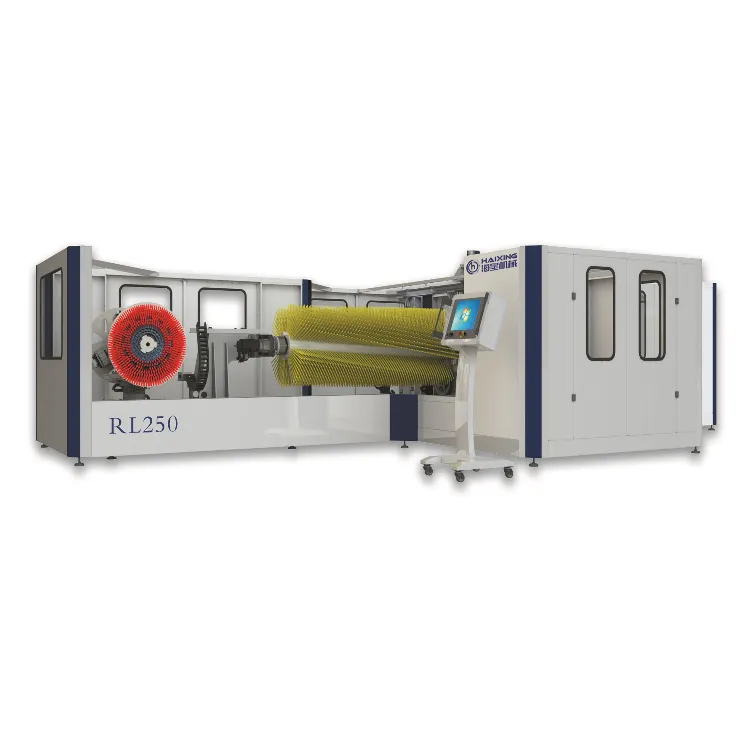
Precision Engineering for Consistent Drill Depth and Tuft Placement
Advanced brush drilling and tufting machines achieve exceptional accuracy through precision engineering. Industry studies show that ±0.05 mm deviations in drill depth can reduce brush lifespan by 30% (Manufacturing Journal 2023), making consistency critical for quality output.
5-Axis CNC Control Ensures Sub-Millimeter Accuracy in Brush Drilling and Tufting
Five-axis CNC systems enable complex angular drilling impossible with conventional setups—eliminating manual errors while maintaining positional accuracy within 0.8 mm during high-velocity operations. Synchronized motion compensates for material variances in real time, ensuring each hole meets exact specifications regardless of production speed or substrate inconsistency.
Tight Tolerance Management: ±0.1 mm Placement Consistency Across High-Speed Cycles
Rigid frame construction and vibration-dampening technologies allow modern machines to sustain ±0.1 mm placement accuracy even at 1,200 cycles/hour. Thermal sensors automatically adjust for expansion during extended runs, preventing cumulative errors that cause tuft misalignment. This repeatability reduces material waste by 22% compared to traditional systems and supports diverse applications—from surgical instruments to industrial sweepers.
Seamless Automation and Integrated Multi-Process Workflow
Synchronized Drilling-to-Tufting Handoff Minimizes Downtime in Brush Manufacturing
Robotic material transfer systems enable near-continuous production by automating the handoff between drilling and tufting. Spindle positioning and tufting head trajectories are synchronized to maintain 98% operational uptime—preventing the 15-minute stoppages per shift common with manual alignment. Integrated sensors verify hole depth consistency before initiating tuft insertion, creating a closed-loop workflow that cuts changeover intervals by 40% versus standalone equipment.
Independent Motion Carriages Optimize Throughput Without Compromising Flexibility
Modular transport systems support parallel processing: one fixture undergoes drilling while another receives tufts. Dual-axis carriages operate independently, boosting output by 35% without added floor space. Servo-driven clamps accommodate varied geometries—from circular scrubbers to angled paint applicators—in under 10 seconds. Programmable logic controllers dynamically adapt toolpaths for mixed batches, enabling efficient high-volume production alongside custom runs of ≤500 units.
Smart Control Systems and Predictive Uptime Optimization
Dynamic Pattern Programming via CNC-Guided Tufting for Custom Brush Configurations
CNC-guided tufting systems execute complex designs—including radial industrial brushes and medical-grade tapered configurations—with sub-0.5 mm precision. Operators import CAD files directly into intuitive interfaces; the system then auto-generates toolpaths, adjusts needle depth in real time, and self-calibrates for material density variations. This eliminates manual reprogramming between batches, cutting setup time by 70% compared to legacy systems.
Remote Diagnostics and AI-Driven Predictive Maintenance for Brush Drilling and Tufting Machine Reliability
AI algorithms analyze real-time vibration, temperature, and power consumption data from spindle motors and tufting heads to detect micro-anomalies invisible to human operators. Failure forecasts are issued 15–30 days in advance with 92% accuracy. Maintenance alerts prioritize interventions based on impact:
| Intervention Type | Impact Reduction | Data Source |
|---|---|---|
| Component Replacement | 85% unplanned downtime | Motor current signatures |
| Belt Tension Adjustment | 40% tuft placement drift | Vibration frequency analysis |
| Lubrication Cycles | 60% bearing failures | Thermal imaging |
This proactive strategy extends machine lifespan by 3–5 years and sustains 98.5% operational uptime—essential for high-volume brush manufacturing environments.
FAQ Section
What is the impact of drill depth deviations?
Drill depth deviations of ±0.05 mm can reduce brush lifespan by 30%, emphasizing the need for precision in brush manufacturing.
How does 5-axis CNC control enhance accuracy?
5-axis CNC systems maintain sub-millimeter accuracy during complex drilling tasks, eliminating manual errors and compensating for material variances.
What role do thermal sensors play in brush tufting machines?
Thermal sensors automatically adjust for expansion during extended runs, preventing errors and ensuring tight tolerance management.
How does automation improve efficiency in brush manufacturing?
Robotic systems automate handoffs in the manufacturing process, cutting downtime and increasing operational uptime.
What benefits do predictive maintenance strategies offer?
AI-driven predictive maintenance extends machine lifespan, reduces unplanned downtime, and maintains high operational uptime.